

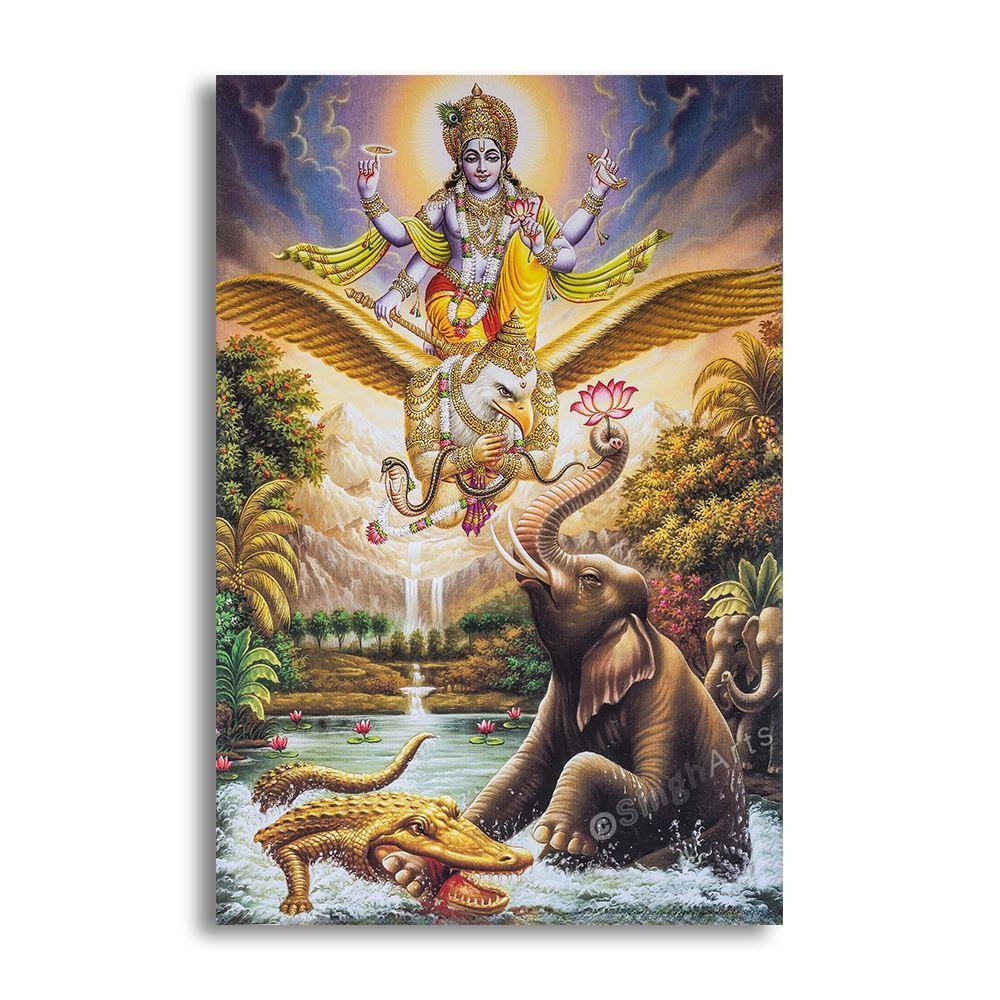
The artwork depicts a powerful scene from traditional Hindu mythology, commonly associated with the episode of Gajendra Moksha. At the center, Lord Vishnu appears in his divine form, descending from the heavens mounted on Garuda, symbolizing swift divine response and protection. Vishnu’s serene expression, radiant aura, and raised weapons signify divine authority, compassion, and the preservation of cosmic order.
Below, an elephant struggles in a river, caught by a crocodile, representing a moment of suffering and helplessness within the natural world. The elephant lifts its trunk upward in a gesture of surrender and prayer, symbolizing absolute faith, devotion, and surrender to God. The water, lotus flowers, and surrounding forest create a living landscape that reflects both beauty and danger, reinforcing the idea of worldly struggle.
The crocodile represents ego, attachment, or forces that bind the soul, while the elephant embodies the devotee overwhelmed by life’s challenges. The act of calling out to God signifies bhakti, where sincere devotion transcends strength, status, or form. Lord Vishnu’s descent represents divine grace responding not to power, but to faith.
Overall, Ek Faryad Hathi Ki expresses a timeless spiritual message deeply rooted in Hindu art and philosophy. It teaches that when devotion is pure and surrender is complete, God becomes the protector. The painting emphasizes compassion, divine justice, and the eternal bond between the devotee and the divine presence.



Reviews
There are no reviews yet.